

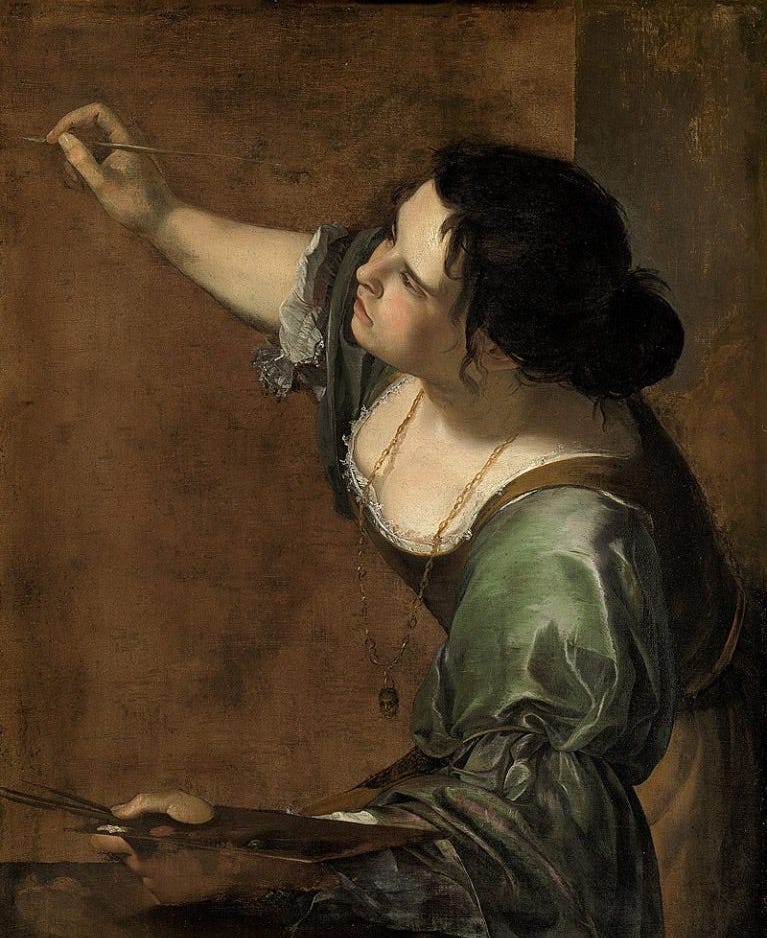
Self-Portrait as the Allegory of Painting by Artemisia Gentileschi, ~1638
Personal privacy, as a concept, was not something I encountered until I was into my twenties. The lack of it forces you to be creative - as a kid, I used to write in my diary in mirror writing, and to this day I can write as quickly in mirror writing as I can the regular way. (Later in high school, I would entertain myself by learning to write with both hands - sadly, not a skill that survived with time). Microsoft Word was a great invention that allowed me to write a lot and to keep prodigious personal journals. By now, I have a big stack of them ordered by year, which form a haphazard map of the upsets in my life. Because of course, you write a lot less when you’re happy, and when things are going well. I don’t have a problem with this, because it is our upsets (however small) that shape our approach to life, and it is our handling of them that defines us most sharply.
I was vaguely browsing some of my old journals the other day and thinking about how the way I write has changed over time. My map of upsets is also of course a map of developing self-definition. The early files seem cringy to me every time, but what I notice now with more compassion is how hard I was working to “write well” and to sound smart. This tendency has almost totally disappeared over the years. I find that as I get older, I write more honestly and I use fewer words to say what I mean. Partly, this is because I understand myself better, but it is also because, I understand better the function that writing plays in my life. It has been a long-standing compulsion because it is one of my primary sense-making tools. Louise Glück says about what writing means to her: “It seems to me that I have wanted to write for the whole of my life. The intensity of this insistence, despite its implausibility, suggests an emotional, rather than literal, accuracy. I think my life didn’t seem my life until I started to write.” Or as Joan Didion famously put it: “I write entirely to find out what I’m thinking, what I’m looking at, what I see and what it means. What I want and what I fear.”
Writing is so close to my heart that I can’t live without it, but I have religiously separated my personal and professional writing. This blog is a way to blur the boundaries between the two, an experiment that I hope I can deepen with time. Because writing about the things that matter the most to you is scary, and difficult - the same way that being perceived for who you are can be difficult, unless you are extremely comfortable with yourself. I find that I am able to write most honestly and sharply when there is no audience, and it’s that form of writing that feels the most powerful and freeing. David Whyte, with his unerring ability to put the unspeakable into words, says, “The place where what you think is you and what you think is not you, and where they meet and form a frontier, is the very place from which you learn to speak and write.” It is when I reach this place that I usually find myself making self-discoveries.
Some of us think better when we write, and find that we express ourselves more eloquently in words than in speech. I’ve never been a great talker, with a mind that tends to drift too quickly to maintain a single conversational thread, and I admire people who are good storytellers, orators, and joke-sayers. These are abilities that totally escape me, like a lost map to a different world. But on a page, I find that I make most sense to myself. Louise Gluck traces the seeds of her writing compulsion to a childhood of constant speech-interruption by adults:“I came to have a sense that the self I was in the world, among other selves, was alternately precarious and invisible. I did not think speech was a good conduit to the self, or expression of it, because in my childhood it was not. The page was different. Here my voice had a stability and an immutability, qualities that I passionately craved and never remotely approached in my social interactions. How could I? Stability and immutability are not characteristics of the spoken word”. I too find comfort in the decisiveness of the written word, in knowing that each word has been chosen, rather than blurted out.
No matter the origins of the desire to write, writers have for millennia unanimously complained about how the act of writing is violently difficult and utterly anxiety-inducing. I think it’s because to maintain an honesty of self and integrity of purpose in front of an audience can take everything out of you. Not everyone has that kind of courage. Being a writer requires guts that most of us don’t have - to examine oneself unflinchingly, to examine the people around you with the same frankness, and to hold your line against a moralistic society that will hate you because it really cannot bear to look at its own truths. The best writing says things that everyone feels but avoids admitting. It surfaces dark social truths that are normalized in everyday life. It holds up a mirror to our hypocrisies and the parts of ourselves that we avoid at all costs. Good writing makes you feel, and it makes you feel seen. And exposing yourself in that way can be terrifying. It is why I laugh when I hear anyone talking about how Generative AI will replace writing. It can weakly imitate human writing, yes - but it does not have courage, passion, or pain - and you can’t have good writing without those things and much more. At its core, writing is an utterly human endeavour that helps us bear the unbearableness of feeling and living. If you wish to outsource even sense-making to a machine model, then why live at all? We might as well give up our five senses, our minds, and our lives away too. Buy one, get six free.
Writing is hard work. And good, hard, work imparts its own sets of pleasures. Maya Angelou says: “I just want to feel and then when I start to work I’ll remember. I’ll read something, maybe the Psalms, maybe, again, something from Mr. Dunbar, James Weldon Johnson. And I’ll remember how beautiful, how pliable the language is, how it will lend itself. If you pull it, it says, OK. I remember that and I start to write. Nathaniel Hawthorne says, “Easy reading is damn hard writing.” I try to pull the language in to such a sharpness that it jumps off the page. It must look easy, but it takes me forever to get it to look so easy”. The paring away of the extras, the ability to remove the noise and to whittle experiences and truths down to essentials, only comes with time. Because it is hard won, it is all the more enjoyable as a practice. It doesn’t matter if we are talking about a private diary or a public writing practice. Like anything, writing deepens and simplifies as it ages.
Aging brings other concerns. You tend to lose some memories and hold on faster to others. And what about those of us who have poor memory in the first place? I often mis-remember details and forget important chunks of the past. For me, writing is also a means of record-keeping, and of bearing compassionate witness to my own life. Anais Nin says, “I needed to live, but I also needed to record what I lived. It was a second life, it was my way of living in a more heightened way”. When I revisit my writing from the past, I often see things in a new light, and I always appreciate how far I have come. It reminds me not to take any joy for granted, and to feel free to live completely in the present.
However, the present can be overwhelming. Every time I open a social media app, a flood of posts - blurring human and AI writing - greets me. The volume of writing here and everywhere is too high, and I don’t know what and how to read anymore. In the digital world, there are many writers who mimic writing, who want to deliver the emotional gut-punch of an excellent piece of writing but at a machine-industrial pace. But you can’t do it dirty like that. Allow it a bit of mystery, some flirting with ideas, time to cook, and a surprise element (will it come when I sit down to write?). All writers are trying to be influencers, and a lot of influencers use writing as their primary medium, but in a sense, the job of a social media influencer runs exactly counter to the job of a writer. Influencers start out sharing authentic self-truths, which attract us to them as an audience. But as their audience grows, they begin to monetize these truths till they no longer reflect reality. Influencers face the pressure to grow fast and maintain high levels of audience engagement and visibility, which compromises the things they are saying to us. Consistent monetization and repeated virality requires making some difficult ethical decisions and often calls for inauthentic strategies.
At a conference talk I heard a few years back, sociologist Ashley Mears spoke about how severe anxiety is a reliable byproduct of the experience of going viral, a finding that stayed with me. The pressure to look perfect and not be hated, in front of a crowd that huge, can be debilitating. Anne Lamott quotes Kurt Vonnegut, “When I write I feel like an armless legless man with a crayon in his mouth”, and she says, “So go ahead and make big scrawls and mistakes. Use lots of paper. Perfectionism is a mean, frozen form of idealism, while messes are the artist’s true friends.” On social media, you’re not allowed to make any mistakes. But you can’t write properly, Lamott reminds us, if you turn this mean-spiritedness of purpose towards yourself. David Whyte also warns of the dangers of allowing anyone else to assess your writing: “There’s always a danger of losing the particularity of your own voice whenever you put yourself too much in someone else’s sphere, as in writing workshops where there is real pressure for you start to sound like everyone else. You can get very good in this kind of greenhouse forcing you to write and speak very quickly, but you may never get beyond just being good because the individual voice is so particular, and I think it should be inured from coercion, subtle or not so subtle, of any kind.”
Perhaps we should all return to private diaries then, and find our voices and truths at our own pace. Are there other modalities which allow you similar kinds of self-discovery? I’d love to hear about them.
If you’d like a prompt to start your private writing practice today, I’ll leave you with these beautiful words by David Whyte (emphasis mine). He is speaking of poetry but I think it applies to any kind of personal writing. (Here is the full interview).
“To write poetry, you must make it very a physical frontier in your own body; our very human bodies are always very emotional at the frontier of realization, and beneath that emotion is the physical substrate from where the emotion arose. That’s where you go to write. Oftentimes at that frontier of realization which you represent through what we call writing, you will break out into tears—at least I do—and that’s when you’ve gotten through this carapace between the way in which the emotion is emanating on the surface and its true source. You’re bringing parts of yourself together that haven’t spoken in a long time. Camus said, ‘live to the point of tears’ not as an invitation to maudlin sentimentality, but to this edge between what you know about yourself and the world and what you are just beginning to understand.
It’s interesting to think of being moved as a practice. Human beings might pride themselves on not being moved until it becomes a barrier to self-understanding. It is interesting to think that there are simple practices such as listening to music in a way that allows you to be moved: by refusing to have it as a background and maybe even turning the lights off while hearing Sheku play the cello. Or to allow yourself to think about the people you love in a moving way. And as I say, it’s not to indulge in becoming emotional but to get to the source beneath, to get to the chordal structure that resonates and brings your body and our voice alive.”
So, spend some time on something that moves you, and then sit down to write for a bit. You might be surprised at what comes out.
This was a fantastic piece. I dont think I can write as well, but I sure am glad that I can read such wonderful text !